Solo Centrum

Surakarta

At the museum no photos are allowed which is really unfortunate as it was well worth the visit and the guided tour is definitely not to be missed. In the museum there are even Batik made from the Dutch era which depicts stories like Little Red Riding Hood and Snow White!

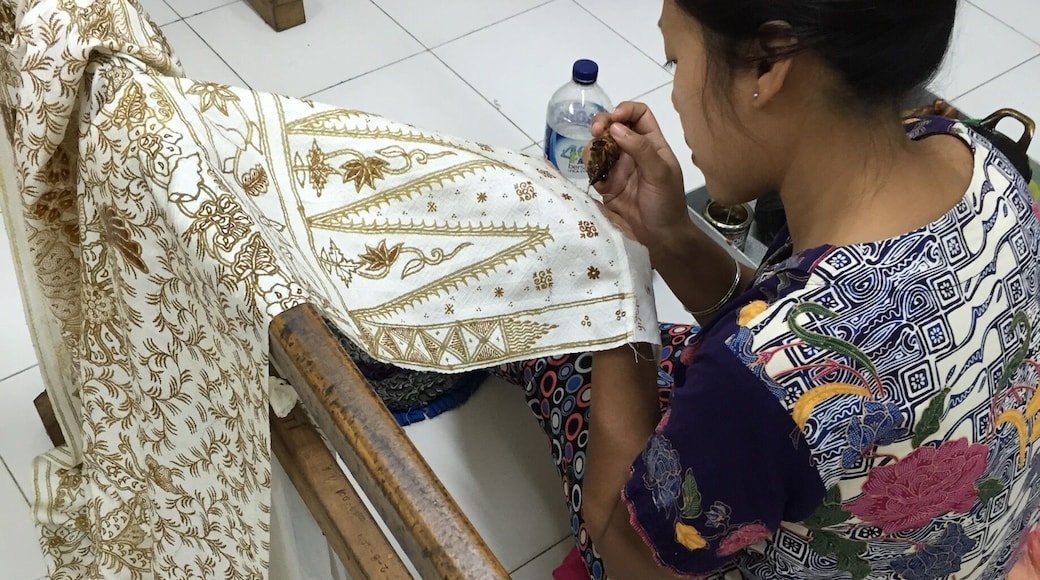
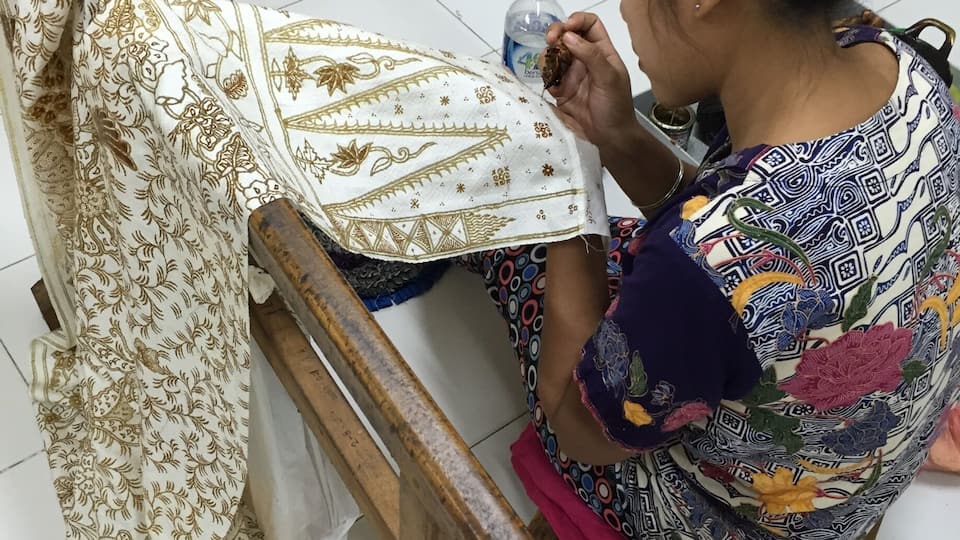
I enjoyed the tour v much and at the end of the tour we were brought to this room where the artisan were working on hand drawn batik.

Below is an excerpt from Wikipedia for anyone interested in learning more about the process of batik making.

Firstly, a cloth is washed, soaked and beaten with a large mallet. Patterns are drawn with pencil and later redrawn using hot wax, usually made from a mixture of paraffin or bees wax, sometimes mixed with plant resins, which functions as a dye-resist. The wax can be applied with a variety of tools. A pen-like instrument called a canting (IPA: [tʃantiŋ], sometimes spelled with old Dutch orthography tjanting) is the most common. A canting is made from a small copper reservoir with a spout on a wooden handle. The reservoir holds the resist which flows through the spout, creating dots and lines as it moves. For larger patterns, a stiff brush may be used. Alternatively, a copper block stamp called a cap (IPA: [tʃap]; old spelling tjap) is used to cover large areas more efficiently.

After the cloth is dry, the resist is removed by scraping or boiling the cloth. The areas treated with resist keep their original color; when the resist is removed the contrast between the dyed and undyed areas forms the pattern. This process is repeated as many times as the number of colors desired.

The most traditional type of batik, called batik tulis (written batik), is drawn using only the canting. The cloth need to be drawn on both sides and dipped in a dye bath three to four times. The whole process may take up to a year; it yields considerably finer patterns than stamped batik.

Source: Wikipedia
At the museum no photos are allowed which is really unfortunate as it was well worth the visit and the guided tour is definitely not to be missed. In the museum there are even Batik made from the Dutch era which depicts stories like Little Red Riding Hood and Snow White!

I enjoyed the tour v much and at the end of the tour we were brought to this room where the artisan were working on hand drawn batik.

Below is an excerpt from Wikipedia for anyone interested in learning more about the process of batik making.

Firstly, a cloth is washed, soaked and beaten with a large mallet. Patterns are drawn with pencil and later redrawn using hot wax, usually made from a mixture of paraffin or bees wax, sometimes mixed with plant resins, which functions as a dye-resist. The wax can be applied with a variety of tools. A pen-like instrument called a canting (IPA: [tʃantiŋ], sometimes spelled with old Dutch orthography tjanting) is the most common. A canting is made from a small copper reservoir with a spout on a wooden handle. The reservoir holds the resist which flows through the spout, creating dots and lines as it moves. For larger patterns, a stiff brush may be used. Alternatively, a copper block stamp called a cap (IPA: [tʃap]; old spelling tjap) is used to cover large areas more efficiently.

After the cloth is dry, the resist is removed by scraping or boiling the cloth. The areas treated with resist keep their original color; when the resist is removed the contrast between the dyed and undyed areas forms the pattern. This process is repeated as many times as the number of colors desired.

The most traditional type of batik, called batik tulis (written batik), is drawn using only the canting. The cloth need to be drawn on both sides and dipped in a dye bath three to four times. The whole process may take up to a year; it yields considerably finer patterns than stamped batik.

Source: Wikipedia

Populære steder at besøge


Mest populære hoteller i Solo Centrum

The Royal Surakarta Heritage - Handwritten Collection

The Royal Surakarta Heritage - Handwritten Collection

5 out of 5
Jalan Slamet Riyadi No. 06 Surakarta Central Java
Prisen er 222 kr. pr. nat fra 19. jan. til 20. jan.
222 kr.
19. jan. - 20. jan.
inkluderer skatter og gebyrer
Overnat på dette hotel med luksusfaciliteter i Surakarta. Nyd godt af gratis Wi-Fi, gratis parkering og spa med fuld service. De populære seværdigheder Mesjid ...
8,2/10 Very Good! (165 anmeldelser)
Average Night
Very nice room space to layout things, large room, nice bathroom. A/C terrible had to move rooms once second room OK. Pool very nice prefect temperature. Staff helpful but lacked English speaking staff. This is a problem for me. No place near to eat.

Anmeldelse fra 7. okt. 2025

The Royal Surakarta Heritage - Handwritten Collection
Novotel Solo

Novotel Solo

4 out of 5
Jalan Slamet Riyadi 272 Surakarta Central Java
Prisen er 213 kr. pr. nat fra 1. feb. til 2. feb.
213 kr.
1. feb. - 2. feb.
inkluderer skatter og gebyrer
Overnat på dette hotel med spa i Surakarta. Nyd godt af gratis Wi-Fi, gratis parkering og 2 udendørs pools. De populære seværdigheder Danar Hadi og Radya Pustaka ...
8/10 Very Good! (113 anmeldelser)
房間乾淨,服務也很到位,有提供飲用水,但是浴室有很多發霉的地方,抽風機會發出巨大的噪音,可能要更換比較好

Anmeldelse fra 4. sep. 2025

Novotel Solo
ibis Styles Solo

ibis Styles Solo

3 out of 5
Jalan Gajah Mada 23 Surakarta Central Java
Prisen er 168 kr. pr. nat fra 29. jan. til 30. jan.
168 kr.
29. jan. - 30. jan.
inkluderer skatter og gebyrer
Overnat på dette hotel med spa i Surakarta. Nyd godt af gratis Wi-Fi, gratis parkering og 2 udendørs pools. De populære seværdigheder Radya Pustaka Museum og ...
8/10 Very Good! (102 anmeldelser)
Good location, nice view room, little bit tight room, great food but need AC around dinning room and elevator because too hot while have breakfast and while in the elevator. Have pool is great but I think is too deep with 1.5 meter pool. Overall is still good place to stay while on vacation in this ...

Anmeldelse fra 15. aug. 2025

ibis Styles Solo
GRAND ORCHID HOTEL SOLO

GRAND ORCHID HOTEL SOLO

3 out of 5
Jl. Gajahmada No.29, Timuran, Surakarta Central Java
Prisen er 148 kr. pr. nat fra 18. jan. til 19. jan.
148 kr.
18. jan. - 19. jan.
inkluderer skatter og gebyrer
Overnat på dette hotel med forretningsvenlig profil i Surakarta. Nyd godt af gratis parkering, morgenmad og spafaciliteter. De populære seværdigheder Radya Pustaka ...
GRAND ORCHID HOTEL SOLO
FIM by Zigna

FIM by Zigna

3 out of 5
31 Jl. Yosodipuro Surakarta Jawa Tengah
Overnat på dette hotel med spa i Surakarta. Nyd godt af gratis Wi-Fi, gratis parkering og spa med fuld service. De populære seværdigheder Nakamura Klinik og ...
9,4/10 Exceptional! (6 anmeldelser)
The hotel is an excellent place to stay. The hotel itself is not special or fancy, but it is well-run, clean, and located in the center of Solo. The breakfast buffet is excellent, the restaurant is good, and the hotel also has a nice cafe with an outside seating area. They featured life music at ...

Anmeldelse fra 19. jul. 2025

FIM by Zigna
Front One Budget Hotel Slamet Riyadi Solo

Front One Budget Hotel Slamet Riyadi Solo

2 out of 5
110 Jl. Slamet Riyadi Surakarta Jawa Tengah
Overnat på dette hotel i Surakarta. Nyd godt af gratis Wi-Fi, en døgnåben reception og kabel-tv. De populære seværdigheder Radya Museumsbibliotek og Mangkunegaran ...
Front One Budget Hotel Slamet Riyadi Solo
Den laveste pris pr. nat baseret på 2 voksne for 1 nat, som er fundet inden for de seneste 24 timer. Priser og tilgængelighed kan ændres uden varsel. Yderligere vilkår kan gælde.

Andre områder i Solo Centrum

At the museum no photos are allowed which is really unfortunate as it was well worth the visit and the guided tour is definitely not to be missed. In the museum there are even Batik made from the Dutch era which depicts stories like Little Red Riding Hood and Snow White!

I enjoyed the tour v much and at the end of the tour we were brought to this room where the artisan were working on hand drawn batik.

Below is an excerpt from Wikipedia for anyone interested in learning more about the process of batik making.

Firstly, a cloth is washed, soaked and beaten with a large mallet. Patterns are drawn with pencil and later redrawn using hot wax, usually made from a mixture of paraffin or bees wax, sometimes mixed with plant resins, which functions as a dye-resist. The wax can be applied with a variety of tools. A pen-like instrument called a canting (IPA: [tʃantiŋ], sometimes spelled with old Dutch orthography tjanting) is the most common. A canting is made from a small copper reservoir with a spout on a wooden handle. The reservoir holds the resist which flows through the spout, creating dots and lines as it moves. For larger patterns, a stiff brush may be used. Alternatively, a copper block stamp called a cap (IPA: [tʃap]; old spelling tjap) is used to cover large areas more efficiently.

After the cloth is dry, the resist is removed by scraping or boiling the cloth. The areas treated with resist keep their original color; when the resist is removed the contrast between the dyed and undyed areas forms the pattern. This process is repeated as many times as the number of colors desired.

The most traditional type of batik, called batik tulis

Banjarsari

Under dit ophold i Banjarsari kan du lægge vejen forbi seværdigheder som Solo Paragon Lifestyle Mall og Balekambang Bypark.

Banjarsari


Solo Centrum

Vælg to eller flere komponenter, og spar penge på din rejse: