Nikiski
Rejseguide
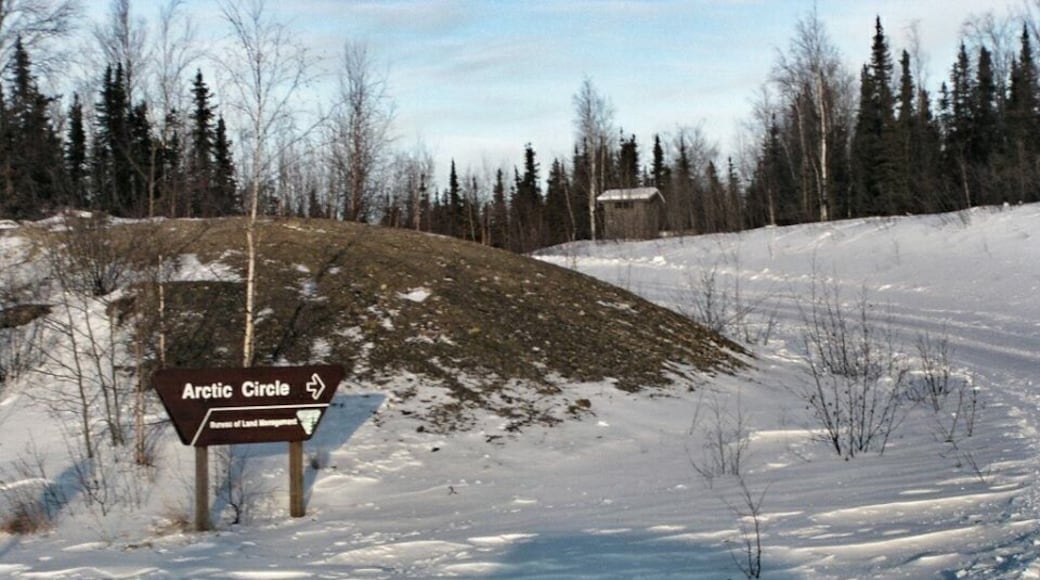
![The Arctic Circle is one of the five major circles of latitude that mark maps of the Earth. As of 16 February 2015, it runs 66°33′45.6″ north of the Equator.
The region north of this circle is known as the Arctic, and the zone just to the south is called the Northern Temperate Zone. The equivalent polar circle in the Southern Hemisphere is called the Antarctic Circle.
The Arctic Circle is the southernmost latitude in the Northern Hemisphere at which the sun can remain continuously above or below the horizon for 24 hours (at the June solstice and December solstice respectively). North of the Arctic Circle, the sun is above the horizon for 24 continuous hours at least once per year (and therefore visible at midnight) and below the horizon for 24 continuous hours at least once per year (and therefore not visible at noon). On the Arctic Circle those events occur, in principle, exactly once per year, at the June and December solstices, respectively. However, in practice, because of atmospheric refraction and mirages, and because the sun appears as a disk and not a point, part of the midnight sun may be seen on the night of the northern summer solstice up to about 50′ (90 km (56 mi)) south of the Arctic Circle; similarly, on the day of the northern winter solstice, part of the sun may be seen up to about 50′ north of the Arctic Circle. That is true at sea level; those limits increase with elevation above sea level, although in mountainous regions there is often no direct view of the true horizon.
The position of the Arctic Circle is not fixed. It directly depends on the Earth's axial tilt, which fluctuates within a margin of 2° over a 40,000-year period,[2] notably due to tidal forces resulting from the orbit of the Moon. The Arctic Circle is currently drifting northwards at a speed of about 15 m (49 ft) per year; see Circle of latitude for more information.
#snow](https://images.trvl-media.com/place/6140564/a9f9449e-bab4-40a6-a9a1-5356b0cc2aa8.jpg?impolicy=fcrop&w=1040&h=580&q=mediumHigh)
![The Arctic Circle is one of the five major circles of latitude that mark maps of the Earth. As of 16 February 2015, it runs 66°33′45.6″ north of the Equator.
The region north of this circle is known as the Arctic, and the zone just to the south is called the Northern Temperate Zone. The equivalent polar circle in the Southern Hemisphere is called the Antarctic Circle.
The Arctic Circle is the southernmost latitude in the Northern Hemisphere at which the sun can remain continuously above or below the horizon for 24 hours (at the June solstice and December solstice respectively). North of the Arctic Circle, the sun is above the horizon for 24 continuous hours at least once per year (and therefore visible at midnight) and below the horizon for 24 continuous hours at least once per year (and therefore not visible at noon). On the Arctic Circle those events occur, in principle, exactly once per year, at the June and December solstices, respectively. However, in practice, because of atmospheric refraction and mirages, and because the sun appears as a disk and not a point, part of the midnight sun may be seen on the night of the northern summer solstice up to about 50′ (90 km (56 mi)) south of the Arctic Circle; similarly, on the day of the northern winter solstice, part of the sun may be seen up to about 50′ north of the Arctic Circle. That is true at sea level; those limits increase with elevation above sea level, although in mountainous regions there is often no direct view of the true horizon.
The position of the Arctic Circle is not fixed. It directly depends on the Earth's axial tilt, which fluctuates within a margin of 2° over a 40,000-year period,[2] notably due to tidal forces resulting from the orbit of the Moon. The Arctic Circle is currently drifting northwards at a speed of about 15 m (49 ft) per year; see Circle of latitude for more information.
#snow](https://images.trvl-media.com/place/6140564/a9f9449e-bab4-40a6-a9a1-5356b0cc2aa8.jpg?impolicy=fcrop&w=1040&h=580&q=mediumHigh)

Besøg Nikiski

Evenson Heritage Lodge

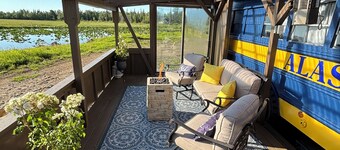
Creekside Cottage nær Danmarks sø
Great place! We loved it and were very comfortable.Beautiful furnishings and thoughtful amenities!Great full range for foodies!Wish all VRBO's were at this level!
Anmeldelse fra 7. sep. 2025

Best Western King Salmon Inn

Evenson Heritage Lodge

Creekside Cottage nær Danmarks sø
Great place! We loved it and were very comfortable.Beautiful furnishings and thoughtful amenities!Great full range for foodies!Wish all VRBO's were at this level!
Anmeldelse fra 7. sep. 2025

Kenai Riverfront i centrum af Soldotna
Property was in a great location, close to everything in Soldotna, and on t
Anmeldelse fra 3. sep. 2025
Populære steder at besøge

Cunningham Park
Udforsk de grønne omgivelser ved Cunningham Park i Kenai. Oplev alt det, som stedet er vellidt for, som eksempelvis sin flodbred, eller brug tiden på aktiviteter som fiskeri.

North Peninsula Recreation Area
Udforsk de grønne omgivelser ved North Peninsula Recreation Area i Nikiski. Stedet er populært for vulkanerne, som du kan besøge, mens du er i området.
Kenai Visitors and Cultural Center
Efter et besøg til Kenai Visitors and Cultural Center, kan du planlægge at besøge andre seværdigheder i Kenai. Oplev det, som stedet er populært for, såsom sin flodbred, eller nyd blot udvalget af restauranter, der serverer fisk og skaldyr.
Kenai River Flats
Udforsk de grønne omgivelser ved Kenai River Flats i Kenai. Udforsk området, som er kendt for sin flodbred og sine kirker.
Challenger Learning Center
Brug lidt tid på at kigge på udstillingerne i Challenger Learning Center i Kenai. Stedet er populært og vellidt på grund af sin flodbred samt sine mange aktiviteter, som du kan prøve kræfter med, som eksempelvis fiskeri.
Captain Cook State Recreation Area
Giv dig tid til at opleve Captain Cook State Recreation Area på din rejse til Kenai. Oplev området, som er berømt for sin flodbred og vulkanerne.